
Ten years ago, Sarah watched our free masterclass on her mobile phone while sitting in a Macca’s (McDonalds). She didn’t own a computer. She didn’t have Wi-Fi at home either, which is exactly why she was at McDonald’s in the first place.
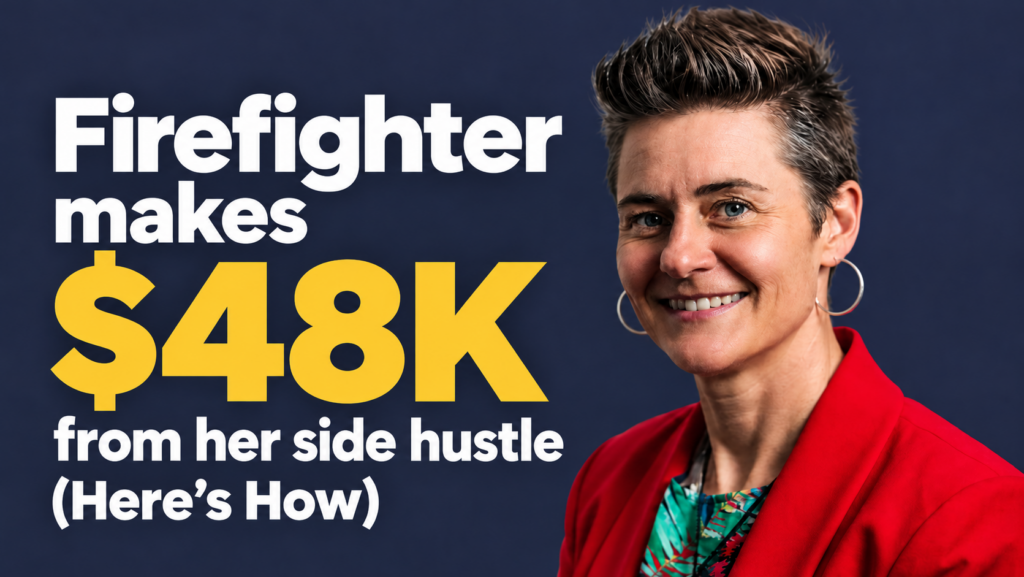
This year, Sarah and her partner Ness, both full-time firefighters working 24-hour shifts and raising 14-year-old triplets, generated just over $48,000 from their own digital agency, Top Gong Digital Marketing. Sarah also took home one of our Champion Cups. Liz and I have known Sarah for the entire decade in between, and I can tell you her story isn’t about overnight success. It’s about persistence, a partner who finally said “I’m in,” and beating the one thing that holds back more capable people than any lack of skill: imposter syndrome.
If you’re a busy parent, a shift worker or a burnt-out employee wondering whether you can realistically start an online business around a packed life, Sarah’s journey is the most honest answer I can give you. Watch our full conversation below to hear it in her own words.
The Macca’s Moment: Where Sarah’s Journey Began
When Sarah first found us, her triplets were about three and a half. Life was, in her words, “incredibly tough.” But Sarah is someone who likes to keep her brain busy.
She’d always dreamed of getting into property investing, and someone lent her a book on the topic. She followed a few links in that book, ended up on YouTube, and somehow went down a rabbit hole that led her to Liz and me talking about investing in websites.
“I didn’t even understand what you were talking about,” Sarah told me. “It was like another language.” She was curious enough to register for our free masterclass anyway.
The catch? She and Ness barely used computers. They each had a mobile phone, Sarah had a computer at work if she needed one, and there was no streaming or Wi-Fi at home. So she drove down to the local McDonald’s, connected to their Wi-Fi and watched on her phone.
That masterclass led her to join our Digital Investors program. I share this detail because so many people tell me they’re “not techy enough” to start. Sarah didn’t even own the equipment. Your starting point matters far less than your willingness to keep going.
Why Sarah Wanted a Career Change to Digital
Sarah is quick to say she’d recommend firefighting to anyone. It’s full of unique experiences and it challenges you mentally and physically. She has no regrets.
But after 10 to 15 years in the job, the shine had worn off. “I don’t want shift work,” she said. “I don’t want a normal day to be someone else’s worst day.”
Initially, she wasn’t looking to leave. She simply wanted a side hustle, a bit of extra income on the side. Over time that shifted, and she started to see the online work as a possible exit strategy, something she could choose to step into fully if and when she wanted.
That’s a really healthy way to approach a career change to digital, by the way. You don’t need to quit anything to start building optionality.
For the first stretch of her journey, Sarah did exactly that. She bought a few small sites on Flippa, built a couple of sites for people and later bought a great little fitness website. But she kept it quiet. “I still didn’t really tell people what I was doing,” she admitted. “It was very much just like an expensive hobby, to be honest.”
The Missing Key: Getting Your Partner on Board
So what changed? Like a lot of people in our community, COVID made Sarah and Ness re-evaluate their lives. Around the same time, Ness lost one of her brothers to prostate cancer, and she had faced serious health battles of her own years earlier.
Both of them were in their 40s, looking at another 20 years in the fire brigade, and asking whether that’s really what they wanted. “Both of us just kind of went no,” Sarah said. “If nothing changes, nothing changes, right?”
Ness had always supported Sarah’s online work, but she’d made her position clear: “You have my full support, but I am not interested.” She’d rather go surfing. Then, after that perspective shift, Ness said she was going to start learning the material herself. Tech was well outside her comfort zone. It didn’t matter.
“I can’t even explain how it was like a missing key, but once she was in mentally, my own productivity just started rising.”
Sarah
Sarah wasn’t just building something for herself anymore. She was building it for both of them.
I’ve seen this pattern hundreds of times. When your partner is genuinely behind you, everything moves faster.
If you’re ready to build that kind of shared future and learn the exact skills Sarah used to buy, renovate and build websites for local businesses, join our Digital Investors program here. It’s where Sarah’s journey properly started, and it’s designed for people fitting this around real lives.
How to Start an Online Business Around 24-Hour Shifts and Triplets
Here’s what Sarah and Ness’s schedule looks like. They both work an eight-day rotating roster: 24 hours on, 24 hours off, 24 hours on, then five days off.
Sounds generous until you factor in the recovery time. Repeated sleep disruption means those days off aren’t always full-capacity days. And because the roster rotates, there’s never a fixed day of the week they’re free.
Add three teenagers with different sports and activities, and you’ve got what Sarah calls “the taxi zone.” So how did they actually make it work? Three practical strategies stood out.
Plan every single week
Sarah is a planner. Because she can never say “every Tuesday afternoon I’ll do this,” she sits down each week and maps out exactly which days she’s working online and which tasks she wants finished.
“It does get hijacked,” she said, “but I have an initial plan A.” Ness, who’s more of a fly-by-the-seat-of-her-pants type, is now working hard to adopt the same habit after a few wobbles.
Protect your focus blocks
Sarah read Johann Hari’s book Stolen Focus and was confronted by the research suggesting it takes around 22 or 23 minutes to get back into the zone after an interruption. She then mapped out an average week with ChatGPT and asked it for an assessment. Seeing how fragmented her working time was turned out to be “a bit horrifying.”
So they made changes. The kids now catch the bus home from school instead of being picked up. It didn’t seem like a big drive, but it was breaking her focus.
Small reshuffles like that have helped Sarah move from 30-minute work blocks toward unbroken blocks of an hour and 20 minutes. That’s a meaningful difference when you’re doing skilled work like web design and SEO.
Divide the load differently
Previously, when both were off, they’d divide and conquer the kids’ activities. Now Ness takes on more of the afternoon runs so Sarah can finish tasks without interruption.
Ness still works in the agency, with some clients she manages, some Sarah manages and some shared projects. But her biggest contribution has been something Sarah lacked for years: the confidence to talk to people and have a go.
Imposter Syndrome: The Real Handbrake
This is the part of Sarah’s story I most want you to hear. Having known her for a decade, I can say confidently that Sarah has never realised how good she is at this.
Before she even joined our Champions mentoring program, she’d figured out rank and rent, renting out websites she’d built to local businesses and making a couple of grand a month from that alone. Every time she renovated a site, I’d tell her it was awesome. She still didn’t see it.
“I either felt like I hadn’t proven myself enough to say that I was that thing, or that I could do that thing, or I felt like something wasn’t good enough to put out into the world yet.”
Sarah
Even when we organised her podcast interview, she told Ness she didn’t feel successful enough to be on it. Ness’s reply? “And this is the problem.”
Imposter syndrome is incredibly common among high achievers. It shows up as undercharging, as building websites for free and thanking clients for the privilege (which Sarah did early on, and got burnt by a couple of people for her trouble), and as keeping your skills a secret.
If you recognise yourself here, know that it’s beatable. Sarah’s proof of that.
Comparison is the thief of joy
Sarah was refreshingly open about a darker phase. She watched people join Digital Investors and Champions after her and fly past her. At first it inspired her. Then it turned into envy, jealousy and comparison.
“I went through a bit of a phase of just becoming a bit disenchanted with it all,” she said. “Why am I even bothering?”
What pulled her through was perspective. Some of those people were working on this full time without kids. For a long time Sarah and Ness couldn’t afford Champions or give it the time commitment it deserved.
Everyone’s at a different stage of life. Once Sarah accepted that, she could celebrate other people’s wins again and return to an inspired mindset. As she put it, your mindset is the direction you go. I couldn’t agree more.
The Barbecue That Led to a Boardroom
The turning point client came from the least corporate setting imaginable: a barbecue. Ness was chatting with friends and asked if anyone knew someone who needed a website. One person piped up that their company’s site was badly outdated.
That company turned out to be a significant business operating up and down the East Coast, with a big presence where Sarah and Ness live.
After some back and forth on the brief, the company asked if they’d present their quote. Sarah and Ness offered to come in person, expecting to meet the one IT contact they’d been dealing with. Instead, they walked into a boardroom with two IT staff, someone from finance and the owner of the entire business.
They were plugged into the big screen and asked to present. Ness froze for a moment, so Sarah started talking about SEO until they found their feet. “We were so far out of our depth,” Sarah said. “That’s how we felt.”
They walked out giggling, proud just to have survived the meeting. Then the company came back: they’d spoken to three agencies and wanted mock-ups from the shortlist. Sarah and Ness delivered those, won the job and completed a five-figure website build.
Now, whenever Sarah drives around her area, she sees that brand’s signage with the URL on it. “We built their website,” she thinks. That’s a pinch-yourself moment, and it did serious damage to her imposter syndrome.
The Numbers: $48,000 in Year One of Champions
Across her first year in Champions, Sarah and Ness’s agency brought in just over $48,000. That included several website builds, ongoing SEO, website maintenance and a couple of rank and rent sites.
For a first year, working around two firefighting careers and triplets, that’s outstanding. It puts them in great company alongside Champions like Kim and Nick, who turned their learning year into an earning year.
Just as important was how Sarah started describing herself. She used to say she was a firefighter who ran “a little bit of a digital agency on the side.” Now, depending on the setting, she’ll introduce herself as running a digital agency and mention the firefighting later.
“I say to myself, it’s not a side hustle, it’s a legitimate business.”
Sarah
Her goal isn’t necessarily full-time hours. It’s earning full-time money without working full-time hours. That’s a very achievable target with a well-run local agency and recurring revenue streams like SEO, maintenance and rank and rent.
Finding Clients Without Traditional Networking
Shift workers can’t commit to most structured networking groups. Sarah and Ness wanted to join BNI because other Champions had done well there, but the fixed schedule simply didn’t fit their roster. So they got creative.
First, word of mouth. Ness started posting on social media to all their friends: did you know we do this? Come and like our page. Sarah was initially mortified. It worked anyway.
Plenty of people had no idea Sarah knew anything about websites because she’d kept it to herself for years.
Second, they found an informal local business group that meets once a fortnight. Between the two of them, one can almost always attend. That group has produced three jobs so far, with another one or two in the pipeline.
And there’s been an unexpected bonus. Standing up, talking about websites and answering questions has helped Sarah “see myself as someone who knows what she’s doing.”
Using AI to Punch Above Your Weight
Both Sarah and Ness have leaned into AI heavily. They started using it for initial content creation, keyword research and competitor research. During the Champions year, they began using it to fast-track website design too.
One of my favourite moments came when a client needed a simple custom app. Sarah tried outsourcing it to a developer she’d used on Upwork, but the solution was clunky. “There’s gotta be a better way,” she thought.
She sat down with Claude and, after roughly 20 rounds of back and forth, built a working solution herself. She was cheering and calling people over to show them. Twelve months earlier, that wouldn’t have been possible for someone without a coding background.
Their next challenge is overwhelm. Since the barbecue, work has flowed in without much effort, so the focus for the coming year is better systems and automation.
They’ve started testing AI agents to handle bottleneck tasks inside client websites, first on a dummy site and now on their first live site. That’s exactly the right move for a growing agency.
The Four-Day Week Tipping Point
Here’s the latest chapter. Sarah recently applied for and won a firefighting position with no night shifts, working four days a week. That frees up two full days each week purely for website work.
Even just sleeping in her own bed every night means she’s “getting more juice for the squeeze” out of her days.
I’ve shared this observation with many Champions over the years. When people transition gently from a five or six-day work week down to four days, that freed-up day is very often the catalyst for real growth.
You don’t have to quit your job to make a career change to digital. You just need to create space, then fill it with focused, valuable work.
Key Lessons If You Want to Start an Online Business
Sarah’s decade-long journey boils down to a handful of lessons any busy professional can apply:
- Start with what you’ve got. Sarah began on a mobile phone at McDonald’s.
- Get your partner genuinely on board. Support is good. Shared commitment changes everything.
- Plan weekly and protect your focus. Small changes, like the kids catching the bus, create bigger work blocks.
- Name your imposter syndrome. If you’re hiding your skills or working for free, it’s running the show.
- Tell people what you do. A single barbecue conversation became a five-figure client.
- Use AI to extend your capabilities. It lets small teams deliver work that used to require specialists.
- Create space gradually. A four-day week can be the tipping point.
Persistence Is the Strategy
“Persistence is key,” Sarah said at the end of our chat. “It’s been a long, slow journey, but it’s definitely moving.” She joked that I’d need about four more pieces of butcher’s paper to plot her growth curve.
But the curve is bending upward now, and with two dedicated days a week, better systems and a mindset that finally matches her skill level, I genuinely believe this is just the beginning.
Sarah’s story shows you don’t need perfect circumstances. You need the right skills, a supportive environment and the persistence to keep showing up, even through the years when progress feels slow.
If you’re ready to start building those skills yourself, explore the Digital Investors program and take your own first step. Who knows? A few years from now, it might be your story we’re sharing.


