
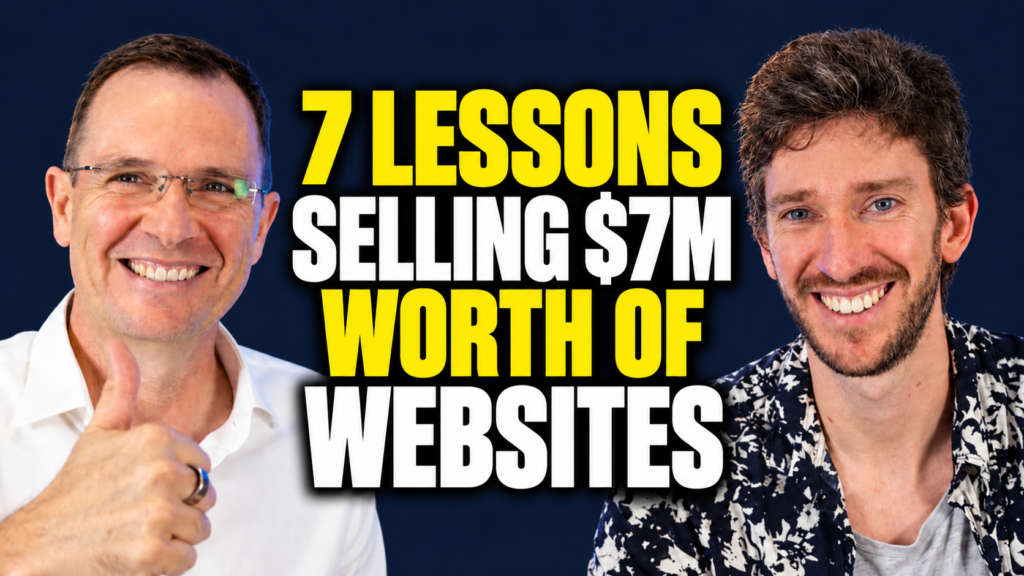
Back in 2012, a young guy walked into our high-end mentoring program with a lump sum of money and absolutely no idea what to do with it. Fourteen years later, he’s one of the most respected website brokers in the industry, with over $7 million in deals across 300 transactions.
His name is Joe, and his journey is one of the clearest examples I know of what happens when you learn the right skills and keep showing up.
I recently had Joe on the Digital Investors Show to talk about how the market for investing in websites has changed. A lot has shifted since the Google updates and the AI wave hit, and plenty of people have convinced themselves that websites are a dead asset class.
They’re not. Joe is closing deals every week, including a $275,000 all-cash sale earlier this year, and he sees exactly what today’s buyers will pay for.
This article breaks down Joe’s story, his view from the front line, and the practical lessons you can apply right now. That includes what you should look for when buying, and what you need to build if you’re planning on selling websites for a premium down the track. Watch the full interview below to hear Joe share these insights in his own words.
Where Joe Started: A Lump Sum and No Clear Plan
Joe’s starting point will feel familiar to a lot of our community. He had capital he wanted to put to work, but the traditional options didn’t excite him and he didn’t know where to begin with online assets.
He found us, joined our mentoring program, and spent a full year learning how to evaluate, buy, improve and sell websites.
Then he did what most people never get around to doing. He actually started buying. From the end of that mentoring year through to 2018, Joe bought and sold his own websites, mostly content sites, often working with partners and investors who helped fund the deals while he acted as the operator.
Liz and I watched him develop quickly, and I personally mentored him through a lot of that early journey. We looked at hundreds of sites together, and he did more due diligence than most people do in a lifetime.
There’s a part of this story that Joe almost forgot to mention. He also became the very first coach at eBusiness Institute. So while I was mentoring Joe, he was turning around and mentoring our clients.
Teaching something is one of the fastest ways to master it, and I think those years sharpened his eye in a way that still shows up in his work today.
The Skill That Changed Everything: Selling Websites Above Market Value
Every investor eventually discovers their edge. For Joe, it was selling. As he put it, he would “frequently sell businesses for way above market value.”
He knew how to present an asset, how to position it for the right buyer, and how to negotiate without leaving money on the table.
People noticed. By 2018, previous clients, including people he’d bought from and sold to, started asking him to sell their sites for them. That demand turned into Just Website Brokerage.
Today, it’s the only business Joe runs. He no longer operates any content sites himself, which gives him a clear, unbiased view of the whole market.
What I love about his brokerage is that it serves the part of the market most brokers ignore.
“When you go to most brokers, if it’s not 100K or more, they’ll turn you away. We go as low as 10K.”
Joe, Just Website Brokerage
That matters enormously for beginners. Small sites are where most of our students start, and having someone who’ll hand-hold you through a five-figure exit is a genuine advantage.
Joe’s path from student to operator to broker didn’t happen by accident. It started with learning a proven system for finding undervalued websites, improving them, and selling them for a profit.
If you’d like to build the same foundation, our Digital Investors Program teaches the exact framework Joe learned, updated for the AI era, so you can start making confident buying and selling decisions of your own.
What’s Really Changed in Investing in Websites
The biggest shift Joe has seen is in where traffic comes from. Over the last couple of years both AI taking over search and Google updates have hit content sites hard.
Small niche content sites built around “how-to” and knowledge-based keywords were wiped out, many of them in a matter of weeks.
Here’s what people miss when they hear that story. The sites that disappeared were, frankly, the spammy, unbranded ones that never deserved to rank in the first place.
Joe and I used to look at those sites together back in the day. Random articles, no brand, no audience, nothing behind them. AI and Google have cleaned a lot of that out, and in a strange way, that’s good news for serious investors.
Traffic Has Moved, Not Disappeared
Content sites that are selling today often get their traffic from social platforms rather than search alone. Pinterest is the standout.
Joe’s brokerage recently sold three or four recipe sites, because recipes perform incredibly well on Pinterest and the platform is very good at sending visitors through to a website.
The strategy is simple to describe, though it takes skill to execute. You get eyeballs on social media, divert that attention to your website, and monetise it there.
For recipe and lifestyle sites, that usually means display advertising through networks like AdSense or Mediavine. But those networks have traffic thresholds, so you need to build the audience before you can apply.
Revenue Models Are Shifting Too
The other trend Joe flagged is the comeback of sponsored posts. This is where a business pays you to publish content with a backlink pointing to their site, which helps their own search rankings.
It’s a model that doesn’t depend so heavily on traffic volume. What it does depend on is authority.
Buyers of sponsored placements look closely at metrics like Domain Authority (DA), Ahrefs’ Domain Rating (DR), and the number and quality of a site’s backlinks. Our long-time champions will know we’ve always loved direct sponsorship deals, and it makes sense they’re thriving now.
In an AI-flooded internet, quality and authority are scarce. Scarce things command a premium.
YouTube, Newsletters and the AI Content Trap
Faceless YouTube channels are growing fast, and the AI tools behind them have become remarkably good. Joe told me about one channel his team was evaluating for a potential sale.
He watched the videos and had no idea they were AI-generated until they dug into the business. His take? It’s both scary and impressive, and the people who learn to use these tools now will be well ahead of the pack.
Newsletters don’t cross Joe’s desk as often, but he was emphatic about their value.
“If you have a newsletter of engaged people about any topic whatsoever, who’s interested in what it is that you’re talking about, that’s valuable, period.”
Joe, Just Website Brokerage
Platforms like Substack and Beehiiv make it easier than ever to build and own that audience.
There’s a catch, though. AI makes content cheap, and readers are getting better at spotting it. Joe’s warning was blunt: if you’re just publishing whatever AI spits out, “it’s not gonna work out very well for you, ’cause anyone can do that.”
This is exactly why we teach our ACE formula. Two of its key elements are a unique Angle that makes your content AI-proof, and a clearly defined customer Avatar that your site serves.
Add a community, even a micro-niche one, and you’ve got loyal followers that no algorithm update can take away.
Branding Is the Word for 2026
I told Joe during the interview that branding is my favourite word for 2026, and he agreed instantly. In his view, branding and authority go hand in hand.
You can’t have a strong brand without authority, and he believes it starts with a crystal-clear purpose before the authority follows.
Joe claimed he’s “not a branding expert.” I disagree. He recognises a strong brand immediately because he’s seen thousands of sites that didn’t have one.
That pattern recognition is precisely what separates experienced investors from beginners, and it’s a skill you can learn.
Joe’s 30-Second Branding Test for Due Diligence
Joe shared a brilliant shortcut for checking whether a brand is actually working. Open Google Search Console on the site you’re assessing, and look at how much traffic comes from people searching for the brand name itself.
For his own business, that means checking how many people search “Just Website Brokerage.”
If a large portion of searches are branded, the brand is doing its job. It’s not always conclusive, but it’s a fast, reliable signal, and it works across every business model, from content to SaaS to e-commerce.
One caveat from me. On small sites under $5,000 to $10,000, branded search will probably be nonexistent, and that’s fine.
Your job as a website renovator is to ask, “What could I do to build a brand here?” Use AI to brainstorm if you need to. If you genuinely can’t come up with anything, it’s a hard pass.
For sites above $10,000 to $20,000, though, you do want to see some branded terms showing up.
What Content Sites Are Actually Selling For
So, are content sites still selling? Absolutely. Joe was clear that there are plenty of good content sites still pulling strong organic search traffic, usually because they’ve invested in brand and authority.
Traffic numbers may be lower than they were five years ago, but these sites are still making money and still changing hands. Here’s how Joe sees the current multiples, based on annual net profit:
- Standard content sites: roughly 2x to 2.6x annual net profit (around 24 times monthly profit)
- Sites with a single traffic source or single revenue source: as low as 1x to 1.5x
- High-quality, diversified content sites: 3x to 3.5x and above, sold with confidence
The discount on single-source sites makes complete sense. If one platform stops sending traffic or paying you, the business can drop to zero overnight.
But look at that from a buyer’s perspective. If you’re an intermediate investor who knows how to add a second traffic channel or a new revenue stream, those 1x to 1.5x sites are exactly where the opportunity lies.
Buy the risk cheaply, fix it, and you’ve moved the asset into a higher multiple bracket. It’s the same thinking that helped Heidi and Mariano buy a $130,000 website for just $30,000.
Case Study: The $275,000 All-Cash Deal
This is the deal I wanted our listeners to hear about. Earlier this year, Joe’s brokerage sold a content site in the business news space for $275,000, at full asking price, all cash, at a 3.3x multiple.
In the middle of all the “websites are dead” noise, that’s a powerful data point.
The site ticked every box. It was aged, it had serious authority, and it had an extremely strong brand. It also benefited from Google News and Google Discover traffic, a category Joe says is seeing a massive surge right now.
The Business Model: A Content Blog on Steroids
The site essentially ran an advanced, highly structured version of sponsored content. It worked with a small number of high-end clients who paid a lot.
Those clients didn’t just buy a single article or a backlink. They bought a string of articles, because they wanted the newsworthiness and PR value of having their story published on a respected outlet.
Joe described it as closer to a content agency or PR agency than a traditional blog. And here’s the part that surprised me: there was very little AI involved.
The business had a real editorial team. AI helped with research, editing and checking, but it wasn’t the first port of call. That human-led quality was a major part of why buyers wanted it.
Three LOIs and a Broker’s Dream
Joe already had a non-binding letter of intent (LOI) from one buyer at an acceptable price, with terms still being negotiated. Then a cash offer came in for significantly more.
That buyer didn’t want an LOI at all. They wanted to go straight to the asset purchase agreement (APA), because they could see the value.
That’s a delicate position for any broker. Joe went with the cash offer, but he had to handle the first buyer respectfully, without revealing the competing offer, which always stays confidential.
On another deal, he juggled three non-exclusive LOIs at once. His rule is simple, even if the fastest buyer isn’t the highest number on paper:
“Whoever pulls the trigger fastest is the one that you wanna go with.”
Joe, Just Website Brokerage
Cash and speed are king. If you’re selling a valuable site, please don’t try to manage that kind of negotiation at home. This is why a skilled broker earns their fee many times over, and why it pays to prepare properly, as Joe explained in our earlier guide on how to sell your online business for top dollar.
What Private Equity Buyers Want Right Now
The buyer of that $275,000 site was a media-focused private equity firm. It buys high-authority, established media properties with editorial teams, and it cares deeply about Google News and Discover traffic.
Joe recently launched a buy-side service, and all but one of his buy-side clients are PE firms. They want deal flow, and when a deal fits, they move fast.
They’re also picky. Joe sends them around ten well-researched deals and they’ll say yes to one or two.
When I asked what tops their list, I assumed he’d say recurring revenue. He didn’t. For these buyers, revenue is almost a non-issue. Their top three are:
- Niche: markets they already operate in and understand well
- Authority: a trusted, established domain with quality backlinks
- Traffic: consistent, sticky visitors, particularly from News and Discover
Joe was careful to point out that this is a specific use case. For the broader market, recurring revenue is still king, because predictable income reduces risk.
But this insight is great news for beginners. If you’re building or renovating a small site, getting niche, authority and traffic dialled in puts you on the path to a strong exit, and the revenue tends to follow.
SaaS and E-commerce in the AI Era
Content sites weren’t the only topic. AI has made a real impact on software businesses, while e-commerce has carried on largely untouched. Both are worth understanding before you put capital to work.
SaaS: Easier to Build, Still Easy to Get Wrong
“Vibe coding” with AI has made SaaS businesses far more common. You don’t need to write code yourself anymore, but Joe warned that you still need to be technically savvy enough to direct the AI properly.
It’s easier than it used to be. It’s not easy.
His biggest warning was about lifetime deals. If you sell software for a one-off fee with permanent access, you’ve already extracted all the value from that customer.
A buyer then inherits the obligation to support those users without getting paid. Savvy buyers will spot that immediately. Build for recurring revenue.
SaaS still commands the highest multiples of any model Joe brokers, mainly because sticky customers rarely switch software they like. In the five and six-figure range, he’s mostly seeing 3x to 4x.
Rare, exceptional businesses still achieve 7x or more, and larger businesses consistently attract higher multiples.
E-commerce: Unaffected, but Not for Everyone
Joe’s verdict on e-commerce was short: “Completely unaffected.” Some of his regular content clients have even pivoted to e-commerce because it doesn’t depend on SEO.
If your paid ads on Meta or Google return more than you spend, you have a business.
He called it a simpler model that’s more complex to run, and I agree. Liz and I started in manufacturing and wholesale distribution, and physical products soak up capital and add moving parts, from inventory to product selection.
I still don’t recommend them for beginners without decent funding. If you do go down that path, buy an established store with a proven track record and do thorough due diligence. That removes a huge amount of risk.
Key Lessons for Your Website Investing Journey
Joe’s story and his market insights boil down to a handful of principles you can act on today:
- Brand and authority beat volume.
- Diversified traffic and revenue earn higher multiples.
- Single-source sites are discounted, which creates renovation opportunities.
- Original, human-led content is becoming more valuable, not less, as AI floods the internet.
Just as important is the bigger lesson in Joe’s journey. He didn’t start as an expert. He started with capital, uncertainty, and a willingness to learn a proven process.
Then he applied it again and again until it became second nature, and eventually built a business around it.
The Final Word: The Opportunity Hasn’t Gone Anywhere
The market for investing in websites has changed, but it hasn’t shrunk. It has matured. Cash-rich private equity buyers are actively hunting for quality assets, and a well-branded content site just sold for $275,000 at full asking price.
The sweet spot for most of our community, from low five figures up into the low six figures, is full of undervalued sites waiting for someone who knows how to fix them.
If you’re ready to learn how to spot those opportunities, renovate them properly and sell them for a premium, the Digital Investors Program is where Joe’s journey began, and it can be where yours begins too.
And when you’re ready to buy or sell, you’ll find Joe at Just Website Brokerage.


