
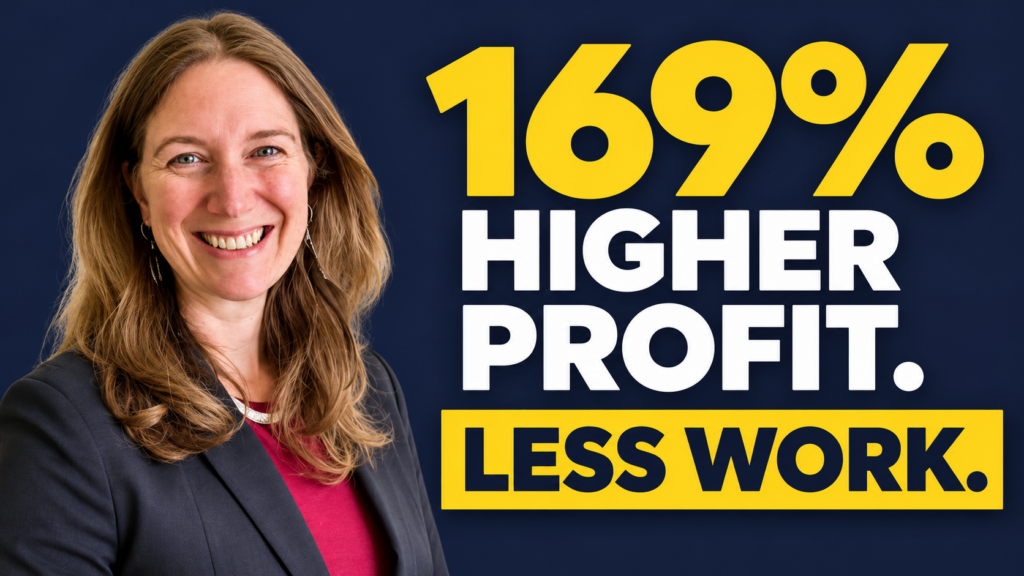
The biggest jump in Dainella’s income over the last year didn’t come from working harder. It came from doing less of the work herself. If you’re a high achiever who has always solved problems by putting in more hours, that sentence probably makes you a little uncomfortable. It made Dainella uncomfortable too, right up until it changed her business.
Dainella has spent the past 12 months training with Liz and me in our Champions coaching program. She runs her own digital agency from a small rural town in Colorado, and this year she won one of our Champion Cup awards. The numbers are impressive, and I’ll share them shortly. But the real story here is about an entrepreneur mindset shift that I see so many capable people struggle with: a ceiling that has nothing to do with the market, the clients or the economy. It’s a belief.
I sat down with Dainella to unpack exactly what that belief was, how she broke through it, and the specific moves you can copy if you’re stuck trading hours for dollars. If you’ve ever considered whether to start a digital agency, or you already run one and feel like you’re hitting a wall, watch our full conversation below, then read on for the key lessons.
From Licensed Electrician to Rural Digital Agency Owner
Dainella didn’t come to us as a beginner. She describes herself as a classic “get ‘er done-er,” and she backs that up with a fascinating career. She started in the trades as a licensed electrician, worked as a wildland firefighter, and spent her 20s and 30s on contract work. Over the last decade, she’s built and run a marketing agency alongside other online businesses.
Her background in the trades shaped how she approaches digital work. “I learned how to build things from nothing, from my head,” she told me. Whether it’s getting the lights on or getting a lead in for a small business, her focus has always been on producing a real result. That craftsmanship mindset is a genuine asset in this industry, where plenty of operators are happy to take the money and run.
But like a lot of self-taught entrepreneurs, Dainella learned by doing, failing and adjusting. She called herself a kinesthetic learner. “It’s a great education,” she said, “but it left some gaps.” Those gaps turned out to be costing her far more than she realised.
The Hidden Ceiling: An Entrepreneur Mindset Problem, Not a Market Problem
Here’s a pattern Liz and I have seen countless times over 15-odd years of coaching. Ultra-high achievers, and particularly many of our female Champions, tend to undervalue what they deliver. They over-deliver, under-charge and assume the answer to any business problem is more effort. It works, for a while. Then the body starts sending bills.
Dainella had been living under exactly this ceiling her whole career. Each time she approached a breakthrough, she’d stretch herself so thin that her health would collapse. “Part of what I kept hitting before that ceiling was that I was stretching myself so thin, my health would implode,” she explained. So when she joined Champions, she was very intentional about building something sustainable this time.
“I Had Been the Thing in the Way”
The structure of the program and the community gave Dainella something she’d never had: a clear view of her own under-earning pattern. She came from a craftsmanship background where you don’t do it unless you do it right. Add the relentless pace of AI and digital marketing change, and doing everything yourself becomes impossible to sustain.
“Eventually, I just kind of hit an implosion point, and I realised that there was no way I couldn’t not over-deliver, and this entire time, I had been the thing in the way. It seems totally obvious in hindsight, but it wasn’t for me.”
Dainella
Part of the problem was trust. Every time she tried bringing someone else in, they failed her tests. She couldn’t find people who shared her ethics and her standard of work, so she kept doing it all herself. Sound familiar? It’s one of the most common bottlenecks I see in agency owners.
How a 169% Profit Jump Came From Doing Less
This is the result that made me want to record this conversation. In her final accountability report, Dainella noted that her gross profit in the last three months of the program averaged 169% higher than in her first eight months. Across her year in Champions, she generated around US$40,000 from her agency work, sitting at roughly $3,000 a month. And that’s separate from her other income streams, in what is meant to be a learning year.
So how did she earn more while working less? She partnered with other members of the program who were experts in their own areas. “We each got to do what we’re best at in a way that benefited not only our own businesses, but our clients,” she said. “And we could do it and take a nice, deep, easy breath because we could trust each other.”
That’s the leverage point. The trust problem that had held her back for years was solved by being surrounded by people who held the same standards. Once she let go of the reins, her income graph did what I’d call a classic hockey stick.
Dainella’s Three Questions for Letting Go
I asked Dainella what advice she’d give anyone struggling to release control and outsource. Her answer starts with brutal honesty.
“Be honest with yourself. What is it that you do really well? And what is it that you do because you think you should do it? And what is it that someone else can do better?”
Dainella
From there, she says, you need to work out what’s required for trust and how to set your partners up to succeed, so the end result matches your standards and your clients stay happy. That’s an important nuance. Outsourcing isn’t dumping tasks on someone and hoping. It’s designing the conditions for someone else to win.
If Dainella’s story resonates and you want to build this kind of leveraged, sustainable online business, the place to start is our Digital Investors Program. It’s where we teach the foundational skills behind building and growing online businesses and digital agencies, and it’s where you’ll connect with a community of like-minded people working toward the same goals. As you’ll see, that community ended up being the thing Dainella valued most.
Want to Start a Digital Agency? Build on What You Already Know
When I asked whether she’d recommend the digital agency model, Dainella gave advice I wish more people heard before they launched. Don’t throw away your past. Build on it.
“I would look to not only where you came from, don’t throw everything out just because you’re moving on to a different model or business or skill. Like, what can you build on that foundation?” she said. For Dainella, that foundation was the trades and small-town rural life.
She understands builders and subcontractors. She knows that when a tradie runs a big crew, they’re a local employer supporting the whole community. “I love talking to people who work with their hands. They’re amazing.”
She also encourages anyone looking to start a digital agency to think about the lifestyle side. Who do you want to serve? What do you want your days to look like? Who do you actually want to be talking to? Those questions shape a business you’ll want to stay in for years, not one you’ll burn out of in eighteen months.
Finding Clients Without a BNI
Interestingly, Dainella didn’t start with a tidy niche. When she joined, I told her to follow the rules, and she took on a wide range of clients early to get momentum. Over the year she narrowed down to trades and home services, plus a few other selections. Today, most of her work comes from referrals.
That referral base didn’t exist when she started. She’d moved towns and let many of her old connections lapse. Her town is too small for a BNI chapter, though it does have a small, active chamber of commerce.
So she showed up to every local event she could. Her method is refreshingly simple: “Just being curious and asking questions and making friends and not being afraid to pick up the phone or reach out to someone and just ask what they’re up to.”
From $500 Websites to $5,000 Proposals
Dainella’s first website through the program was priced at just $500. Then something remarkable happened. The client paid her an extra $700 without being asked. “It just warms my heart. That woman gets it,” Dainella said. That client understood the value she’d received far better than Dainella was pricing it.
By February, Dainella was pitching $5,000 websites plus $1,000 a month in ongoing services. Even so, she admits the under-earning pattern was still strong at that point, and those offers were significantly underpriced for what she delivers. She doesn’t regret the work, because she loves who it serves. But it showed how deep the pattern ran.
“I was the constraint on my own profit.”
Dainella, from her accountability notes
When I read that line back to her, she laughed. “Oh, totally. Still.” She wants to help everyone, and she’s honest that she may never fully kick that habit.
What changed was seeing what more experienced Champions were charging and realising she was offering massive value. In a rural market, with her website and SEO skills, she has a serious edge over local competitors, much like Rohan, who ranked number one for web design in his regional town just six weeks after launching.
Why She Walked Away From a $10,000 Job
It hasn’t all been smooth sailing, and I’d be doing you a disservice if I only shared the wins. During the year, Dainella pulled a proposal for a $10,000 job. In a competitive group where everyone’s tracking numbers, that’s a big call. She’d never pulled a proposal before.
Her reason? “It was going to take me in a direction that wasn’t aligned. It was the old pattern that was going to lead to burnout.” The project was worthwhile, the people were great, but it would have steered her whole business off course.
She learned to tell the difference between work that’s hard because it’s work, which she loves, and work that feels hard because it’s out of alignment. She described learning to trust her intuition as a skill in itself.
Saying no brought tremendous relief, but it required overcoming deeply ingrained habits. “That’s why I joined eBusiness,” she said, “to finally have the structure and the community and the mentorship to catch these things so that I just didn’t rebuild again into burnout.”
Two Months Sick and Still Profitable: The 45-Minute Rule
About a third of the way into the program, COVID hit Dainella hard, followed by complications. She was operating at a fraction of her normal capacity for roughly two months. For a type A perfectionist who felt she was falling behind, that’s a brutal stretch.
But adversity forced a breakthrough. She leaned on one of my sayings that she says cracks her up: “Give it to me in 45 minutes.” Whatever the task or document, find the version that can be done fast.
“I had to finally learn another one of my ceilings about over-delivery is, how can I actually get that 20% that’s going to move the needle 80%?” She also got sharper about which AI tools were worth learning and which rabbit holes to avoid.
Here’s the lesson I want every reader to take from this. On average, the people we coach lose at least four weeks a year to sickness, holidays, family emergencies or kids getting sick. Dainella lost two months, and her best results came after that.
You don’t need a perfect year. You need a model that’s going to help you survive a bad month or two.
Choosing Clients You Can’t Lose For
So what does Dainella’s business look like now? She’s become highly intentional about client selection. “Ones that I just can’t lose for, honestly. Easy wins,” she said. Her filter is whether applying her skills, team and systems will deliver a 3 to 10X return over time for the client.
Beyond the numbers, she does what she calls a vibe check. Are they growth-minded? Do they understand that everything in business is an experiment with no absolute guarantees? They might live very different lives, but if they’re interested in expansion and moving forward, it’s a fit. “I stack the cards as much as I can, and then I vibe check.”
That combination of skill and selection is, in my view, the winning system. When you can build exceptional websites and you deliberately pick clients you know you can get results for, it becomes a win for everyone. Dainella also sees flexibility as the key skill now, as the pace of change accelerates for both her clients and her own business.
Living the Three Ws With a Binge Work Rhythm
Listening to Dainella, I realised she’s now living what we call the three Ws: work when you want, where you want, and with whoever you want. She’s in the Rocky Mountains, outdoors every day, choosing her clients deliberately. She even recently spent 10 days co-leading a straw bale building workshop.
How does a self-confessed perfectionist make time for that? Partly through AI, but she’s careful to say it can be a rabbit hole as easily as a lever. Start by identifying where your time is burning and which systems you’re missing, then look for tools that actually solve that problem instead of creating more busy work.
The other piece is rhythm. Dainella works in intense waves followed by real breaks, something Liz calls binge working. Coming from years of contract work in firefighting and the trades, it feels natural to her. It’s a rhythm that suits shift workers too, as we saw with two full-time firefighters who built a $48K digital agency around their 24-hour shifts.
Dainella’s Advice If You’re Stuck Trading Hours for Dollars
I finished our chat with some speed questions. When I asked for one belief she had to let go of this year, she answered instantly: “That working harder is how you solve everything.” Honestly, the whole interview was worth it for that line alone.
Then I asked what tool she’d hate to lose. I expected Claude or ManageWP. Instead she said, “I couldn’t lose my community, Matt.” Tools come and go, and you can always replace them. What she’d miss are the people she supports, cheers on and riffs strategies with. In this AI age, I think that’s the smartest answer anyone could give.
Finally, for someone in a time-heavy job who’s scared to leave, her advice was gentle and practical. Start listening to the podcast. Take the free course. Fit it in around your life.
“Eventually, what your next step is that takes away from job time or something else will feel natural and normal to you, because no one else knows what that is.”
Dainella
The Takeaway: Your Ceiling Is a Belief
Dainella’s year is proof that the right entrepreneur mindset matters as much as the right skills. She already knew how to build excellent websites. What unlocked a 169% jump in gross profit was letting go of control, partnering with people she trusted, pricing closer to her value, saying no to misaligned work and accepting that 45-minute versions often move the needle just as far.
As she put it, “When you lay the foundation right, the roof is easy.”
If you want to start a digital agency or build a sustainable online business on your own terms, you don’t have to figure it out alone or the hard way. Join us in the Digital Investors Program, learn the skills, and find the community that helps you catch your own ceiling before it catches you.


