
Most people who listen to the Digital Investors Podcast aren’t asking me how to sell a website for seven figures. That’s a nice problem to have down the track. What they’re really asking is far more urgent and far more human: how the hell do I quit my job, and can I do it earlier than I think?
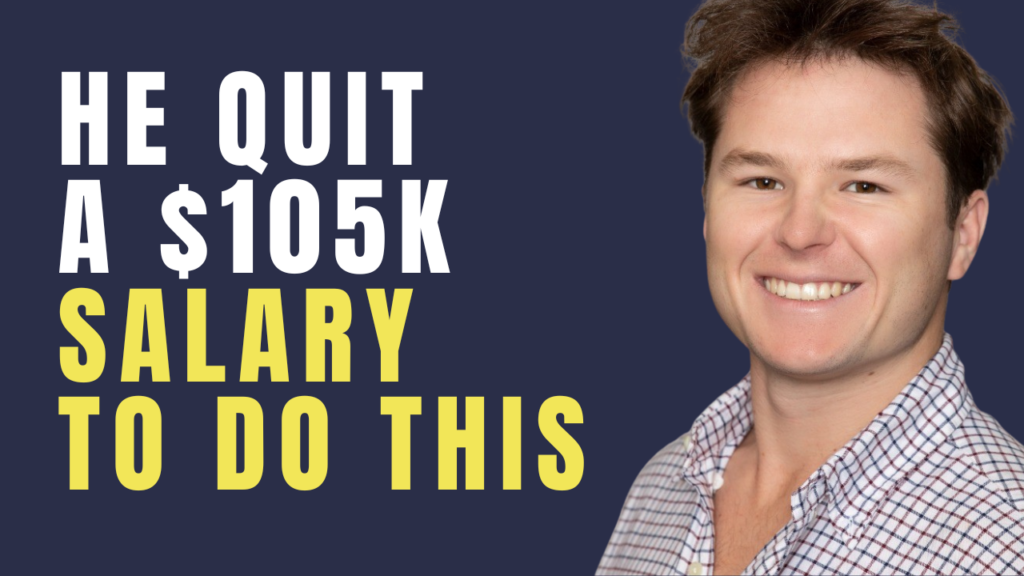
That’s exactly why I wanted Henry on the show. He’s not a polished exit story with a big cheque and a highlight reel. He’s 25 years old, and just a couple of months ago he was an electrical engineer earning $105,000 a year. Today he’s out of that job, running his own digital agency as one of Best Web designers in East Brisbane, and he pulled the whole thing off faster than even he expected. His story is a masterclass in what’s actually possible when you do the numbers properly and back yourself. Watch the full conversation below.
The Golden Handcuffs Nobody Warns You About
Henry’s day looked like a lot of yours. Up early, out the door at 6:15am, home around 4:15pm. Call it a ten-hour day, five days a week, and he was cooked. “I was just very much burnt out and felt like I was on the treadmill and wasn’t really going anywhere,” he told me. “And just needed to change.”
Here’s the thing about a good salary at a young age. It traps you. Henry figured out something most people don’t work out until their forties: he had the golden handcuffs on already. Every day he’d drive home trying to think of a way out. Deep down, he knew he wanted to be in business. He just couldn’t see the exit door.
And this is where I love working with people who are financially literate, because engineers especially love a number. When Henry and I got on a coaching call, I didn’t give him a pep talk. I asked him to fact-check his own life. What actually lands in your bank account each month? He knew it to the dollar. $6,196 after tax. Very engineer of him.
The $28.60 An Hour Reality Check
Now, that number sounds fine on its own. But a salary isn’t just about what hits your account. It’s about what you give up to earn it. So we factored in the full ten-hour door-to-door day, the commute, the traffic, the whole thing. Fifty hours a week building someone else’s asset.
When you divide it out properly, Henry was effectively earning $28.60 an hour. So I asked him a simple question, and I’ll ask you the same one. Would you pay someone $28.60 an hour to sit in traffic and build someone else’s business?
“I think that’d be a resounding no to that question,” he said. Exactly right.
Compare that to those of us who work from a laptop. From the minute we open it, we’re effective. No commute. Big tax advantages. You choose when you work, where you work, and who you work with. That’s the three W’s we teach, and it’s the entire point of learning digital skills. Your effective hourly rate becomes something completely different, and on top of that, you’re building your own asset instead of somebody else’s.
Do The Runway Maths Before You Quit Corporate
I want to be very clear about something. I’m not in the business of encouraging young people to rush out and quit good careers. That’s reckless. What I did with Henry was help him bounce the numbers around so the decision was based on evidence, not emotion.
Here’s the maths that changed everything for him. If you build one website for a local business and charge around $3,000, you only need one build a month to essentially cover your basic living costs. One. Some months you’ll land two or three. Some months you’ll land none. But if you’ve got savings for a runway and you only need one build to keep the lights on, the risk profile looks completely different. It’s the same approach we’ve seen work time and again — from FIFO workers building a side income in their spare time to professionals making the leap full-time.
“When we looked at the runway and I actually broke down the cost, it gave me that sigh of belief. If everything went poorly, I still had this runway to build my skills up. It gave me that bit more confidence to really give it a crack.”
That’s the whole game. Confidence isn’t a feeling you wait for. It’s what you get after you’ve done the numbers and understood your worst-case scenario. And for Henry, the worst case was almost laughably safe. No capital risk. No debt. No staff or materials to lose. If it all went pear-shaped, he could go back to engineering. In fact, his boss told him he’d welcome him back with open arms and wants to catch up every quarter. That’s not a downside. That’s a safety net most business owners would kill for.
Want To Build The Same Skills Henry Used?
Everything Henry did, the website builds, the SEO, the client conversations, the AI workflows, came from the training and coaching he got inside our program. He didn’t have these skills a year ago. He learned them, applied them while still working, and proved the concept before he handed in his notice. And now Hew Digital is a prominent SEO Company in East Brisbane
If you’re reading this and thinking “that could be me,” this is your natural next step. Our Digital Investors Program teaches you the exact skills to build websites, rank them, land local business clients, and build a digital asset you actually own. It’s the same path Henry walked, and the same coaches who guided him are there to guide you. Go and take a proper look at what’s inside.
Look At Your Boss. Do You Want Their Life?
The financials stacked up. Emotionally, the burnout was real. But I gave Henry one more test, and it’s one I want you to sit with too. Look around your workplace. Look at your bosses. Now look at your bosses’ bosses. Is that the life you want in thirty or forty years?
Henry didn’t hesitate. “No, definitely not. I look at their lives and think, I actually don’t want to be where they are. I want to be the person who owns the business.”
That’s the right answer, and it comes from somewhere real. Henry grew up on a wheat and chickpea farm five hours west of Brisbane, watching his mum and dad run their own operation. His original plan was to work in engineering, save capital, then buy into a business. But he quickly realised you can’t just buy a decent business cheaply anymore. You need serious capital behind you. Meanwhile, none of the bosses ahead of him were even thinking about that kind of move. They were happy to go about their day. Nothing wrong with that. It just wasn’t the life he wanted. If you’ve ever asked yourself whether there is a better alternative to real estate for building wealth, Henry’s path offers a compelling alternative answer.
Proof Of Concept: $12K While Still Working Full-Time
Now here’s the part that made me completely comfortable backing Henry’s decision. Before he quit, while grinding out those fifty-hour weeks, he’d already generated $12,000 in sales from his side hustle. That’s not a theory. That’s proof of concept.
How did he do it with no spare time? Cold calling on his lunch break and after hours, plus networking. His very first client came from a cold call, and it wasn’t just anybody. He’d noticed a poorly performing website belonging to one of the best-known business brokers in Brisbane. He picked up the phone, spoke intelligently about what was wrong with the site, and won the job. I know that broker well. Small world. For a 25-year-old to land a connection like that from a cold call is seriously impressive.
The rest came through BNI, a worldwide business networking group with hundreds of chapters. Henry joined a Brisbane chapter while still employed, showed up to the 6:45am meetings, and squeezed the one-to-one catch-ups into his lunch breaks. Was it terrifying? Absolutely. “Huge imposter syndrome,” he admitted. “Who am I to be presenting myself as this person? But getting out there and talking to people pulls you out of that imposter syndrome. It builds so much confidence.”
Cold calling is brutal when you’ve never done it. But learning to do it at 25 is a skill that will change your entire life, whatever you go on to do.
The First Week Back That Sealed It
Henry quit on the 28th of May. And then he did something I love. He and his partner flew to Europe for three and a half weeks. A clean, proper break with a clear line between the old life and the new one.
He was nervous about it, naturally. “Why the hell am I going overseas now? I’ve just quit my job.” But our coach Derek gave him solid advice: take the break properly, because you don’t want to come into your business already burnt out. You want to be clear-minded and making good decisions. So Henry switched off, rested, and came home ready.
Then the universe gave him a wink. In his very first week back, he had three meetings, all potential clients, and he closed every single one at $3,500 each. That’s around $10,500 in a week. And every one of them signed onto monthly maintenance packages too, so it’s not just one-off revenue. It’s recurring income building on top of each build.
By the time we recorded this, he was on track for close to $15,000 in his first full month, with another client he was 99% sure he’d win. Remember, I told him one build a month would cover his costs. He’s an overachiever, that one.
How AI Makes It Easier To Start An Online Business Today
Here’s something I really want you to hear if you’re not technical. Henry does the strategy, the keyword research, the customer avatar work, and the design brief himself. That’s where the value is now. Then he hands the build off to two outsourced techies, one in Pakistan and one in Nigeria, hired off Upwork at around $15 US an hour. Compare that to his old $28.60.
AI does roughly 80% of the heavy lifting these days, from drafting the sites to generating content. And this genuinely wasn’t possible even twelve months ago. “I used to get scared about building websites,” Henry said. “There was this big misconception that it’s really difficult and only certain people can do it. But anyone can learn. You just put the work in.”
Funnily enough, his engineering brain loves the data side. SEO, analytics, keywords, schema, understanding what actually makes a site rank. Anyone can throw a website together. But if you want businesses to actually call back, the value is in the foundations. That’s the bit AI can’t do for you, and that’s the bit we train hardest.
Henry’s Advice If You Want To Quit Corporate Early
I asked Henry what he’d say to someone his age sitting in a job, wondering whether to jump. His answer was gold.
“You really need to surround yourself with like-minded people. It’s so easy to get stuck around people who don’t have any goals. Get out of your shell, go to networking groups. And if you have a goal, just have a go. I’m young, I’ve got no dependents, I’m not married yet. What have you got to lose? Life’s too short not to take risks. If you have that goal, have a crack now, or you’ll regret it later.”
The Takeaway
Henry’s story isn’t about luck, even though he’d be the first to say he got a few lucky breaks. It’s about doing the work in the right order. He proved the concept while still employed. He calculated his runway and his worst-case scenario before he quit. He set a vision as a kid and made it real. And he invested in learning the digital skills that let him start an online business with almost zero capital and almost no downside.
That’s the model. No debt, no staff to lay off, no materials, no premises. Just a laptop, some skills, and the willingness to get out of your shell and talk to business owners. If a 25-year-old engineer who was terrified of HTML a year ago can build this, the only real question is what’s stopping you. Henry’s story sits alongside others like the ex-lawyer who walked away from an eight-year career to start her own online business — proof that this model works across industries and backgrounds.
If you’re ready to build the same skillset and give yourself the same options Henry now has, take the next step and explore the Digital Investors Program. It’s how Henry learned to do all of this, and it’s where your own runway starts.


